

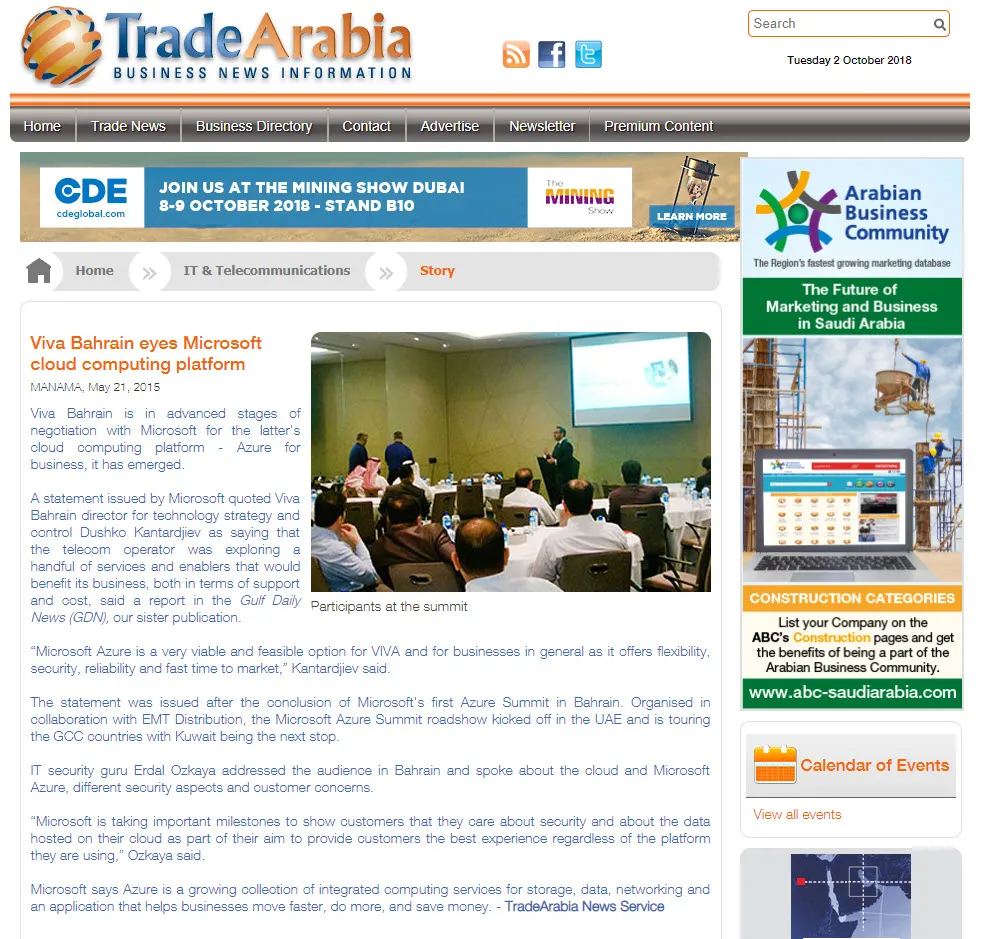
Viva Bahrain is in advanced stages of negotiation with Microsoft for the latter’s cloud computing platform – Azure for business, it has emerged.
A statement issued by Microsoft quoted Viva Bahrain director for technology strategy and control Dushko Kantardjiev as saying that the telecom operator was exploring a handful of services and enablers that would benefit its business, both in terms of support and cost, said a report in the Gulf Daily News (GDN), our sister publication.
“Microsoft Azure is a very viable and feasible option for VIVA and for businesses in general as it offers flexibility, security, reliability and fast time to market,” Kantardjiev said.
The statement was issued after the conclusion of Microsoft’s first Azure Summit in Bahrain. Organised in collaboration with EMT Distribution, the Microsoft Azure Summit roadshow kicked off in the UAE and is touring the GCC countries with Kuwait being the next stop.
IT security guru Erdal Ozkaya addressed the audience in Bahrain and spoke about the cloud and Microsoft Azure, different security aspects and customer concerns.
“Microsoft is taking important milestones to show customers that they care about security and about the data hosted on their cloud as part of their aim to provide customers the best experience regardless of the platform they are using,” Ozkaya said.
Microsoft says Azure is a growing collection of integrated computing services for storage, data, networking and an application that helps businesses move faster, do more, and save money. – TradeArabia News Service

CISO Insight
Having worked at Microsoft and held the Microsoft MVP award since 2009, I have watched the Microsoft security ecosystem evolve from a standalone antivirus product into one of the most comprehensive security platforms available. For organisations invested in the Microsoft ecosystem, understanding how to leverage these native capabilities is one of the highest-ROI security decisions a CISO can make.
The Microsoft Security Ecosystem: A CISO’s Perspective
Microsoft’s security portfolio has expanded dramatically over the past decade. What began with Windows Defender and basic endpoint protection now encompasses identity and access management (Entra ID), cloud security posture management (Defender for Cloud), SIEM and SOAR (Sentinel), endpoint detection and response (Defender for Endpoint), email security (Defender for Office 365), and data loss prevention across the entire Microsoft 365 ecosystem. For organisations with significant Microsoft investments, this integrated approach provides visibility and control that would require multiple third-party vendors to replicate.
The strategic advantage of the Microsoft security stack is integration. When identity, endpoint, email, and cloud security share a common data model and management plane, correlation and automated response become dramatically simpler. A suspicious sign-in detected by Entra ID can automatically trigger an endpoint investigation in Defender, restrict email access, and create a Sentinel incident — all without manual intervention. This level of cross-domain automation is difficult to achieve with multi-vendor architectures.
Practical Considerations for CISOs
While the Microsoft security stack offers compelling integration benefits, CISOs should evaluate it with the same rigour applied to any vendor investment. Key considerations include licensing complexity (security features are distributed across E3, E5, and add-on licences), the need for Microsoft-skilled security personnel, potential vendor concentration risk, and coverage gaps for non-Microsoft platforms. The most effective approach for many enterprises is a Microsoft-first strategy supplemented by specialist tools for specific use cases where Microsoft’s capabilities are less mature.
Frequently Asked Questions
Is the Microsoft security stack sufficient as a standalone solution?
For organisations with a predominantly Microsoft environment and E5 licensing, the native security stack covers most enterprise security requirements. However, organisations with significant non-Microsoft infrastructure, specialised compliance needs, or advanced threat hunting requirements may benefit from supplementary solutions. Evaluate against your specific threat model and operational requirements rather than adopting a one-size-fits-all approach.
What Microsoft licence is needed for comprehensive security?
Microsoft 365 E5 provides the most comprehensive security feature set, including Defender for Endpoint P2, Defender for Office 365 P2, Defender for Identity, Defender for Cloud Apps, Entra ID P2, and Sentinel entitlements. E3 includes basic security features. Many organisations start with E3 and add specific security components through add-on licences based on their risk priorities.
Related reading: For Zero Trust implementation with Microsoft technologies, visit our Zero Trust Security Hub or download the CISO Toolkit.